
FSW Chapter 1
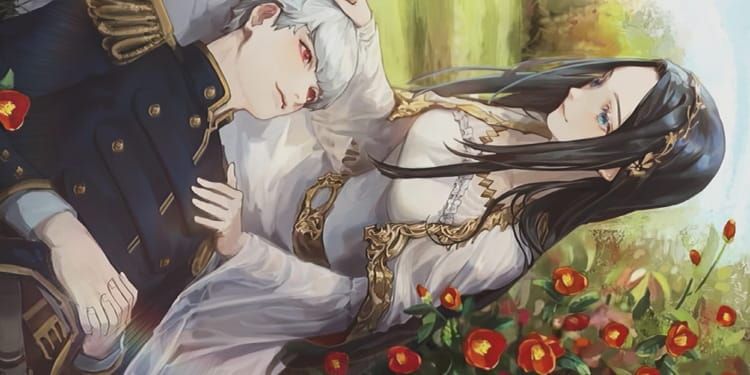
Memory
Heavy air. A funeral prayer. The suffocating scent of lilies.
The scene felt unreal, and Nishina had kept her gaze fixed on the ground—until, at last, she raised her head.
The sky above was a vivid, unbroken blue. That was clearly wrong.
There was a saying in the Snow Empire: Rain falls from a clear sky. In its literal sense, it meant the death of a member of the imperial family. The bloodline of the imperial house was said to carry the blood of water spirits—when that blood grieved deeply enough, the sky wept with it, and rain fell even without a cloud in sight. And so it was: when someone the imperial bloodline had loved closed their eyes for the last time, rain fell from a clear sky.
But sunlight beat down—warm, almost harsh, needling against her eyes.
Nishina dropped her gaze, stung.
Beneath that brightness, she could see clearly: a pair of white fists, trembling finely. He stood watching the Emperor present a single flower with a face drained of all expression—and he was biting down on something.
Aiden Heinrich Aren of White Snow.
Imperial Prince of the Snow Empire. The only child of Empress Kiyonné, whose funeral this was. And Nishina's half-brother.
He passed the Emperor without a word exchanged between them and stepped up to the dais. He laid the flower in the arms of the Empress—who lay with her eyes closed as if sleeping. White lilies. The flowers she had loved. Every time Nishina had encountered her in the palace, that lily fragrance had clung to her, impossibly sweet.
The moment Aiden laid those spotless white lilies—not a speck of dust on them—and offered his final farewell, the sky began, slowly, to cloud over.
No one startled at the late-arriving rain. The attendants had been waiting with umbrellas in hand from the beginning. Perhaps it was the unbroken clear sky until moments ago that had been strange.
Tok. A drop of rain fell against her cheek. Cold.
The reason this rain—so very late—felt this cold: it came from grief that belonged only to him.
A handmaid appeared without a sound and raised an umbrella over her. But the cheek already wet with it was damp enough to have been tears—or to look it.
Nishina blinked her water-heavy eyelids, slowly. Through a view now blurred further, she could see him standing alone.
He had dismissed even his attendants. He stood in the rain with nothing between him and it. His chin was held as high as always—yet somehow it seemed precarious. Was that her imagination?
As Nishina looked on with helpless concern, she happened to meet his eyes. His gaze, that clear blue.
In that instant, she understood: her concern had been imagination. What moved in his eyes was not precariousness.
Something more violent than grief.
It was rage.
She stepped back reflexively against the cold of it. Even as her gaze lost its bearings, scattered and confused, his eyes pressed outward with a relentlessness that would not stop.
The breath she hadn't noticed she was holding broke its rhythm. Her lungs felt too full. The sound of rain was sharp and painful on her ears. And above all, her head was spinning—badly, badly spinning.
This unbearable sense of recognition that she couldn't explain.
Stagger. One step back, her face contorting.
Rain at the tips of her shoes. People in black. The dizzying lily scent. And rage—a rage like an animal's, that seemed to want to tear everything apart.
"—! —"
Scenes forced their way into her mind as though something were pressing needles through it, and her mouth fell open. The memories carrying pain were not hers—and were, at the same time, entirely hers.
At the end of those memories flickering past like frames, she finally read the conclusion of all of it.
And then Nishina's body gave way. After that: darkness.
A cold season, breath hanging white in the air. In a dark forest with snow falling thick, Nishina looked up at a figure standing over her. Eyes red as blood—the color that was the opposite of hers—looked down at her without feeling.
The purpose of the hunter her brother had sent was singular. To kill the prey that troubled him.
In a moment, the shining blade in the man's hand would cut her throat.
Strange—that she felt no fear at all, even now. She didn't quite understand why.
Perhaps because some part of her had always known a day like this would arrive.
Her brother. Whose rightful place as Crown Prince had been threatened—though he carried the Empress's blood—simply because he had been born of a loveless union. Who had to endure alone, weighed perpetually against her, who had been born of the Imperial Consort's bloodline, born of love.
Her own peaceful childhood had always had his unhappiness as its floor.
How she had regretted it—that she was named Crown Princess in the end, when everything in her had resisted it.
She had never imagined that water spirit healing abilities, awakened so late, would become so powerful a foundation of support. If she had known that in the end it would all amount to taking what should have been his—she would have kept it secret for the rest of her life.
Only when things had gone too far to reverse did she understand, with the full weight of it, what she had wanted.
For having been nothing but his enemy.
For every moment she had turned away, frightened of his hatred.
Would something have changed—if she had found courage without giving up, even in the face of his cold refusals?
But regret is always too late, and suppositions are always hollow.
He had returned from the war with victory in his hands, and the blade he turned toward the imperial palace was inevitable as the next step in a sequence. With the Empress's home kingdom and his network of supporters at his back, there was nothing to give him pause.
She remembered it clearly—the carnage, blood and screaming filling the air. In that hell, the moment her mother's neck fell and her father's. Those eyes full of fury. Those eyes full of emptiness. She could not forget them.
It was in that moment that she had finally understood. The depth of the despair he had endured.
Regret had choked her more than resentment ever did. That was probably why.
From that day forward, she had thought of the ending that would come for her—thought of it every day.
A quiet end, alone in a vast forest. Compared to what she had steeled herself for, it was not a bad way to go.
Nishina closed her eyes without any disturbance, her heart quiet.
"Your last words."
The man spoke in a tone as empty as his eyes. A low, settled voice that seemed to pool in her ears.
If she had last words to leave him—
When she had been cast out to somewhere lower than the earth rather than granted death, Nishina had settled in a small, run-down infirmary. A place where the line between living and dying was a single thread's width. She had heard more last words than she could count.
People who confessed love. People who gave their thanks. People who sobbed that they didn't want to die. People who poured out resentment and curses.
But to him—to someone she could neither resent nor love—what words was she supposed to leave?
The deliberation was brief. There was only one thing left in her chest that she had not yet let go of.
"…May you become a sun that shines upon even the lowest places of the empire."
A cold snowflake landed on her cheek, melted, and slid down.
And then Nishina finally woke.
Her mouth was dry, rough-feeling. She opened her eyelids slowly, pushing them upward.
The splitting headache and the thirst of someone thrown into a desert for days—her brow creased without her choosing it.
When her vision finally found its focus, the familiar ceiling of her room met her eyes.
"Your Highness has finally woken!"
"Shina!"
She turned her head—weakly—toward the woman rushing to her. Her eyes were wet with recent tears, and they looked at Nishina with desperate relief.
"…Mo…ther…"
She called to her in a voice scraped raw, and the woman's composure gave way entirely, all at once. Nishina was sorry to have worried her—but the crying was making her head hurt worse.
The imperial physician must have noticed the worsening color in Nishina's face, because he gestured quietly to the handmaids.
"Shall we help you sit up?"
She nodded, and Joy carefully supported her. Nishina swallowed a few mouthfuls of the water Joy offered, and only then did her voice come out properly.
"Mother, I'm all right. Please."
"But—you wouldn't wake, not for days, and I thought—I thought something terrible had happened to you—!"
After the bad illness years ago, her mother had started at even a mild cold. She had probably not left Nishina's side or eaten properly for days.
An indulgent thing to think, perhaps—but in moments like this, she occasionally wondered if it might be easier on her mother to love her a little less. Nishina managed a helpless smile, and the imperial physician stepped in to help settle the Imperial Consort.
"She will be fine now, but she still needs rest. You haven't slept properly in days either, Your Highness—it would be best to take your leave for now."
"…Yes. All right."
The Imperial Consort swallowed her tears and nodded. She promised to visit again in the morning, and then—at last—she left. The imperial physician followed, leaving a few instructions behind him.
Joy insisted she would stay, but Nishina asked her quietly to let her rest alone, and Joy departed, and every line of her retreating back was reluctance, dripping with it.
Silence settled into the room. Nishina let out a slow breath.
Her eyes had opened to her mother's face, and she'd managed not to show it—but her head was noise from the moment she'd opened her eyes—noise pressing at the walls.
She had dreamed. No—not dreamed. Remembered. In the falling snow, she had been killed by her brother's knight.
And that was not all. Everything until now—and everything that was yet to come—she remembered it.
Looking back, she had often felt that strange sense of recognition from childhood. The day of her seventh birthday, when a rose garden arrived as a surprise. The day her nanny Michelle left the palace for personal reasons. All of it had felt familiar—like living through something a second time.
After enough of those moments, it had stopped feeling strange: the sense of knowing someone she'd supposedly never met, or understanding how an unfamiliar situation would unfold before it did.
She had always explained it away—something similar must have happened, once—and moved on. But what came crashing in the moment she met Aiden's eyes was not something she could explain away as déjà vu.
This was not something she had lived through before. It was something she had read.
His rage would behead the Emperor and the Imperial Consort. Drive a blade through countless retainers. And eventually, it would take her head, too. She had seen that terrible future.
Seen it—in another world, as another self—in a book.
Nothing specific came back about that world, or about who she had been in it. But one book remained in her memory. Its title was For the White Snow—a work depicting the life of a single protagonist from beginning to end.
The novel told, in rough strokes, the story of a protagonist who had grown up unloved, and who reached the throne through every kind of adversity. A common enough story: someone raised with much love—the female lead—would come to bring peace to a protagonist hollowed out of feeling.
The unusual thing about this otherwise unremarkable novel was what the author had done in the opening: a considerable act of misdirection.
The early chapters were written as if the princess were the protagonist. The author described her in terms of baeseol—black hair and white skin, the imagery of white snow.
But as the story progressed, it became clear: the protagonist—the true white snow—was not the princess but the prince. Because the skin that was beautiful as snow, white and fine as snow, was not hers alone. It was his as well.
The reversal had been stunning enough that the back of her head still stung with it, in memory. But right now, who the protagonist was hardly mattered.
What truly mattered was this: the protagonist, the prince—her brother—would overturn the imperial palace by force and seize the throne in blood.
Nishina thought of her own death in the memories she had recovered.
The princess—sent away alone, without even an escort—had settled quietly in a hidden place, healing the sick. But as her network of supporters persisted and her name grew, almost against her will, into something resembling a saint's—Aiden eventually sent his knight to have her killed.
That was the death waiting for her. More terrible still for this: despite everything she had wanted, she would die in the end as his enemy, not as anything else.
She hadn't resented him—not even then. The version of her from that other world had clicked her tongue at the princess for it—but now that it was her own situation, it wasn't so incomprehensible.
Even now, knowing this cruel future, she felt no hostility toward him. Not a thread of it.
She suspected that even if it came to that moment again—even if he raised his sword to her—she still wouldn't be able to hate him—probably.
But she would not be choosing that ending this time around.
She did not want to watch her family die. She did not want to lose everyone she cared for. And she did not want him to seize a blood-soaked throne and spend the rest of his life grinding along a road of thorns.
She had no desire, not even the smallest, to compete with him for that crown.
If she could simply place the crown in his hands before things went wrong—he would have no need to walk a path soaked in blood to claim it, and she would have no need to lose everything.
Of course, to do that, she would need the Emperor to acknowledge that the prince was more fit to lead than she was. And she would need to avoid—at minimum—being hated by Aiden.
And above all, she would need to earn the sympathy of the knight whose sword would one day find her throat.
Like the hunter who helped Snow White escape rather than kill her.
Member discussion