
TMIAP Chapter 1
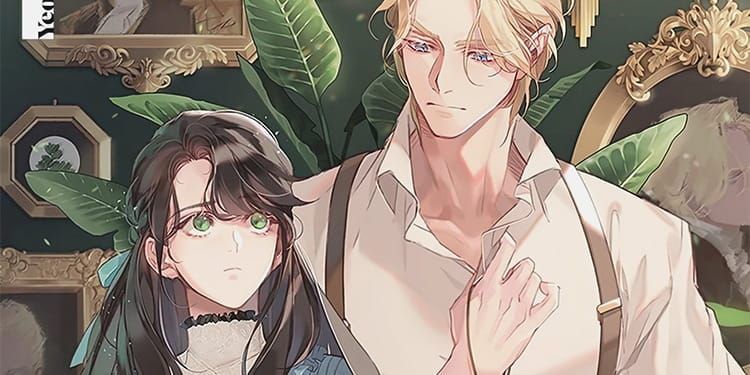
A beautiful mansion. Roses that five gardeners had labored for days to coax into bloom. Beneath the summer night's gaslight, the flowers spilled over in reckless bloom.
If the word wealth had a landscape, this was precisely it.
A view worth losing oneself in—but Monica could not afford to. The man in front of her prevented it.
"You're saying you're not Garcia."
Monica found herself at a loss.
One might fairly argue that she had simply lost herself in the man's face rather than the garden. He was, objectively, that sort of man. Inordinately tall. Golden hair that anyone would have called magnificent. Eyes deep enough to be unsettling.
"How many times must I say it. I am not called by that name."
Cold, his expression as he answered.
Monica examined him again with care.
Now that she actually looked—he was, it was true, dressed rather expensively. The precise opposite of everything she associated with the person she knew.
'Is he genuinely someone different?'
Mistaking one person for another was not unusual, of course. She had done it twice already, recently enough.
'...Wait. This situation is far too familiar.'
Monica pressed her fingers to her furrowed brow.
Hadn't she initially mistaken Garcia for Luis? Before she could collect her thoughts, the question had escaped her.
"Surely you're not about to tell me your name is Luis."
"Ha."
The coldness at the corner of his mouth gave way—briefly—to a smile.
Nothing like Luis's smile, which had been warm as sunlight. The face was too similar, though, to be a coincidence.
He denied her inference by producing a new name.
"My name is Enrique Solivén."
"...Excuse me?"
She couldn't believe it. In recent days she had met two men with the same face.
Golden hair. Blue eyes. Impossibly tall.
All of it identical to the man standing in front of her now.
Which meant Monica was, at this moment, meeting the third man with the same face.
Three men, all with the same face, all entirely different people?
"A lie... It's a lie, isn't it."
Monica's eyes went wide.
Because when he laughed—pfft, a breath barely escaping—the right side of his face twitched for a fraction of a second. And in that instant, the banquet hall's light threw a contrast across his cheek, and Monica saw it: a shadow pooling at the outer corner of his eye, spreading and deepening into hollows.
"A waste of time, all of this."
He turned. His step had no hesitation in it whatsoever. Monica felt the urgency arrive.
What was at the man's cheek—no, at his eye—was a scar. Barely visible. But unmistakably one she recognized.
"Wait, please!"
Her hand caught the hem of his jacket. He turned back, brow drawn.
"Your— might you be... no. Triplets?"
Standing this close, she could see it more clearly: through the hair damp with perspiration, the scar at the outer corner of his right eye. And the small scar at the edge of his lip. Monica knew these scars.
"Though I've never seen twins—or triplets—with the same scars in exactly the same places."
Or, at the very least, someone with multiple personalities.
To tell the story of Monica's encounter with a man who was, at minimum, a liar and, at maximum, someone with multiple personalities, we must go back several days.
It would also be worth pausing to understand Monica herself.
Monica disliked being asked her name.
"Name?"
"Monica."
She swore it was not the name she objected to. The one who had given it to her was the orphanage director—taken, apparently, from the name of a precious princess in some kingdom or other. Once Monica had learned its provenance, she had rather liked the name itself.
The trouble was always what came after.
"And Monica...?"
"Your surname?"
When Monica let the question hang, whoever had asked would invariably press her.
Then Monica would smile with studied ambiguity—or sometimes roll her eyes as she answered.
"I haven't one. I'm an orphan."
The other party's response would become equally ambiguous.
Or:
"Oh dear..."
With a trailing murmur, eyes averted—the exact same eye-rolling she had just performed—followed by a hasty pivot to an entirely different subject.
So of course she disliked it.
Not that Monica had no surname in the literal sense. The orphanage director, keen to extract every penny of government subsidy, had diligently registered every orphan's birth—but had given them all the same surname.
Monica had come across the ledger once by accident: children listed in rows, that identical, careless surname running alongside each name in turn.
She made her decision looking at that page. She would rather state flatly that she had no surname than speak that one aloud.
The director was not entirely without justification.
'You'll all be changing your surnames when you're adopted anyway, won't you?'
Heavens! Even so—who registers every child under the same name?
And if you aged out of the orphanage at eighteen without being adopted, you would carry that name for the rest of your life. Good heavens, what a dreadful thing.
"...phen. Miss Phen."
What a dreadful...
"Miss Orphen!"
"Oh! Yes!"
Lost in her thoughts, Monica startled badly and answered at full volume. Every pair of eyes in the vicinity swung toward her at once—then slid away in the same instant. Monica's face went scarlet.
Monica Orphen.
Her surname was the word for orphan with just one letter changed.
She'd sooner introduce herself as an orphan to someone's face than go through life with a name like that.
But this time there was nothing to be done. She was, at this particular moment, sitting at a job interview.
The woman who had called her by that dreadful surname—and thus saved her from her own reverie—was a middle-aged woman with her hair arranged rather becomingly, who introduced herself as Mistress Oraingne, head housekeeper in service to a wealthy noble family.
The tearoom occupied a sunny corner of the commercial district. Light filtered through the opaque glass of the windows and fell aslant across Monica's face.
She was not without confidence in her appearance.
Not, of course, the kind of confidence that usually comes with such a claim—the kind that implies beauty of the stop-you-in-your-tracks variety, or a face that earns words like stunning.
Monica's confidence was a different variety entirely.
Sharp green eyes. Black hair of good texture, neatly twisted up. The best dress she owned—a navy taffeta with long, narrow sleeves, composed and properly restrained.
In short: she looked extremely capable.
Precisely the correct impression for a woman seeking a governess position in the household of a comfortable aristocratic family.
And a governess position was indeed what Monica was after.
Fortunately, Mistress Oraingne did not pursue the question of Monica's surname any further. Monica's mood lifted somewhat.
"Your letter of introduction was well in order. The reference is solid. You worked as an army nurse, I understand."
"Yes—I was stationed in the same unit as Miss Diana."
"Excellent. Sacrificing oneself for one's country—that spirit of self-giving is precisely the virtue young ladies today so sadly lack."
"I am most grateful for your kind opinion."
'I didn't quite see it that way.'
Monica's tongue remained civil while something else moved beneath it.
At the time Monica had enlisted, the kingdom was two years into a war. The front needed bodies; the crown promised generous terms to women who volunteered as nursing sisters. Two hundred sing a month, and university funding available to any woman who served over two years.
She had not enlisted to sacrifice herself for her country. She had enlisted for the two hundred sing a month and the university.
The university in question was not a distinguished one. But she'd had no other options. So she had enlisted.
Life, however, did not arrange itself to her specifications.
She had spent three and a half years at the front—somehow—and the kingdom had, rather separately, lost the war. The back wages could not be paid; there were reparations to consider. The city where the women's college stood had been bombed, and the college demolished entirely.
So Monica, now twenty-two years of age, had been obliged to find a new plan.
Fortunately, Diana—a nursing colleague she had been close to during the campaign—had pointed her toward a position. A wealthy semi-noble family residing in the harbor city of La Spezia was seeking a governess. They had a young child in poor health who required light instruction and care.
Governess was, in practice, something of a courtesy title; what they actually needed was a nurse from morning to evening. But the salary was reasonable.
Monica had spent a sleepless night on the train and arrived in the early hours, and the city had seemed, at first sight, quite promising. She was quietly relieved.
La Spezia. The kingdom's southernmost resort—serene in appearance, but peculiar: the sea currents ran so rough that anyone who did not know these waters would invariably run aground. The war had never touched it once. Toward the end, the king himself had taken refuge here; and nobles enough to count had since settled in, waiting for the shattered kingdom to reconstitute itself around them.
Money flowed through the city, inevitably. It breathed wealth.
For Monica, who had spent years at the front, it was simultaneously galling and gratifying.
"I was thinking of introducing you to the household tomorrow. You should be able to start quite soon—assuming our mistress finds you suitable, of course."
"Will accommodations be provided in the meantime?"
"Yes. I've arranged for you at an inn near the train station."
Mistress Oraingne looked faintly concerned at this and raised a hand to her mouth.
"Oh, my. That's not quite the neighborhood for a young woman new to the city."
"Is it not? It seemed clean enough to me..."
"Oh, cleanliness isn't the issue."
Mistress Oraingne adjusted her posture with a light air.
"La Spezia station wasn't in use during the war, you see, so the area around it has rather gotten away from itself. People get lost there regularly. The streets are quite confusing."
"Ah..."
Monica let her gaze travel toward the window. 'I'll need to leave early, then.'
It seemed to be Mistress Oraingne's way of warning her not to be late.
Working alongside this woman might not be unpleasant.
The housekeeper gathered up the tea service and rose; Monica straightened to her feet in turn.
Mistress Oraingne laid two coins on the saucer for the tea and spoke in passing as she prepared to leave.
"There is one thing I've been wondering."
"Please, go ahead."
"Are you, by any chance... an orphan?"
Whatever tentative hope Monica had entertained of a decent position evaporated with those words. She kept the smile, though.
"Because of the surname," Mistress Oraingne added, by way of explanation.
That wretched surname.
Monica managed a gentle nod.
"Oh dear... You've had quite a time of it."
Mistress Oraingne patted Monica's shoulder, unprompted and somewhat unnecessarily. There followed a few remarks of the kind that offer no particular comfort but feel too obligatory to omit—and then, at last, Monica was able to take her leave.
The moment she turned away, a long sigh escaped her.
'Too kind-hearted, as always. That's the trouble. I shouldn't have been so kind-hearted—not then.'
Monica murmured this to herself, very quietly, as she walked. After all this time.
'I really should have gotten myself adopted.'
She'd had her chance at a decent surname. She had kicked it away with her own two feet.
Ironically, twelve-year-old Monica had been too kind-hearted.
Member discussion